
MAINTENANCE SHOULD NOT BE A THANKLESS JOB. LET US FIX IT. | Everybody cheers the jumper. Nobody learns the name of the person who packed the parachute.
Your building has not flooded in six years. That is not luck, and it is not the roof being generous. Somebody has been folding that parachute. This article is for him, and it is about getting his name written on it.

1. The jumper gets the photograph. The person who packed the chute gets a checklist and silence. Your roof has a packer.
2. Production creates the cash flow. Maintenance keeps that cash flow even. No spikes, no surprises, no nine o'clock call about soaked insulation.
3. You are not a glorified janitor. You are the reason the forecast holds.
4. Sixteen departments and one of you is why the roof gets whatever is convenient and cheap. That is a math problem, not a character problem.
5. Chemistry does not care how hard anybody tried. You cannot put rubber over rubber or silicone over silicone and expect a bond.
6. More roofs are ruined by aggressive cleaning than by no cleaning. Bleach, high pressure and household degreasers all do real damage.
7. Every six months: cleaned, touched up, evaluated, documented, and signed. The signature is the part nobody thinks about and it is the part that protects you.
A Brief Interruption, and We Are Sorry
Below is a list of questions and answers. It sits near the front because the internet is largely operated by robots now, and the robots have to be told plainly what a page is about before they will let a human being find it.
So we answer the obvious questions first, in the format the crawlers prefer, and then we get on with the writing. If you are a person, skip ahead. If you are a search engine, we hope this helps and we would appreciate the referral.
Frequently Asked Questions
Q: How often should a commercial flat roof be cleaned and inspected?
A: Every six months. Cleaned, touched up, walked, evaluated, and documented with dated photographs. Spring and fall suits most buildings, because you catch winter damage coming out and you prepare for it going in.
Q: Can our in-house maintenance team handle the roof themselves?
A: Parts of it, yes, and well. Debris and silt removal, keeping drains and scuppers clear, walk pads, and small spot repairs using the correct material. What needs to be outsourced is cleaning, drainage correction, wet insulation, seams across a wide area, and anything that will carry a warranty.
Q: Can you pressure wash a commercial roof?
A: Carefully or not at all. Above roughly 3,000 psi you are no longer cleaning, you are cutting. Blasting seams, edges and perimeter details drives water underneath the membrane, and once it is under there it does not come back out.
Q: Can you use bleach on a roof membrane?
A: No. It degrades the membrane and attacks the adhesives holding seams and flashings down. The same applies to house wash, general degreasers and all purpose cleaners. Adhesive on a legacy rubber membrane is fragile and a degreaser will decouple it. The caulking simply lets go.
Q: Why did the patch fail after one winter?
A: Usually surface preparation, a missing bonding primer, or no fabric reinforcement embedded in the repair. A liquid repair is a system rather than a smear. It also fails when the new material is chemically wrong for what is already on the roof.
Q: Can you put a new coating over an existing rubber or silicone roof?
A: Not like for like. Rubber over rubber will not bond and silicone over silicone is a known mismatch. The product has to be selected for the surface it is going onto, which is why anybody who sells you a pail without looking at your roof is guessing.
Q: Whose fault is it when the roof finally fails?
A: Almost never the maintenance department's. The failure usually traces back to a scope nobody ever wrote and a small repair nobody ever funded. The person closest to the problem gets named because he is closest, not because he caused it.
Now, The Actual Article
Who Packed the Parachute
The jumper gets the photograph. The packer gets a checklist and silence.
If you have spent any time around the military, you already know where this is going.
A parachute gets packed by a person. That person follows a sequence, checks it, and signs it. Then somebody else steps out of an aircraft and lives, and the photograph that gets taken is of the jumper. Nobody at the ceremony asks who folded the silk.
The packer does not usually mind. That is the culture of the work. But there is a reason the packer signs the card, and it is not sentiment. It is because the signature says a competent human being was accountable for this, on this date, and you can look it up.
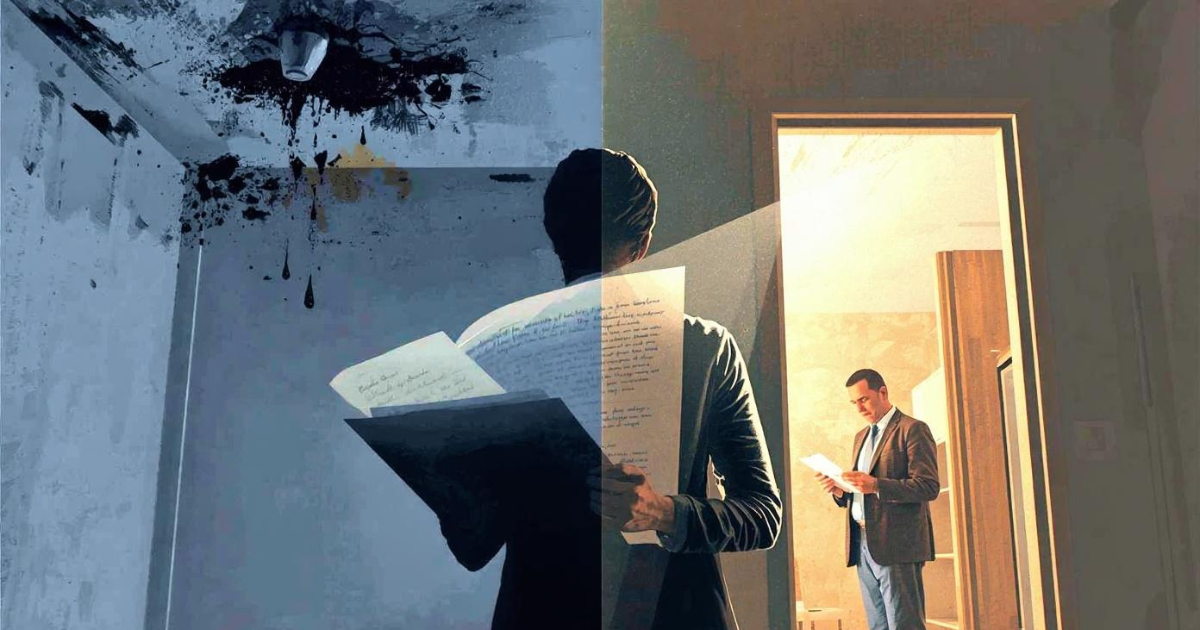
Your roof has a packer. It is probably you. And nobody has ever asked you to sign anything.
The Mill Floor
Everybody applauds the tonnage. Almost nobody applauds the person who kept the machines oiled.
Picture a mill running well. Output is up, the line is moving, the numbers are strong. There is a meeting where somebody presents those numbers and the production team gets the applause, and they have earned it.
Now count who is not in that room. The person who kept the gearboxes oiled and pulled the samples. The person who kept the shop swept and the grounds presentable so a customer driving in did not think twice. The person who kept the roof secure over every one of those machines.
None of that shows up on the output chart. It only shows up if it stops.
A facilities man told me flat out earlier this year, without bitterness, just tired: I am basically a glorified janitor. He said it the way somebody says a thing he has decided is true.
It is not true, and the rest of this article is the argument.
What You Actually Do
Production creates the cash flow. You are the reason it stays even.
I sat with a man in Valparaiso this summer who has spent his career blending industrial lubricants for steel mills. He gave me the clearest version of this I have heard.
Production is the lifeblood, he said. Production turns material into cash flow, and cash flow is how everybody gets paid. Everyone in the building understands that and can see it.
Maintenance does not make a dime. Maintenance prevents losses, and a prevented loss is invisible by definition. Nobody walks the floor after a strong quarter and says look at all the money we did not lose.
But here is the part worth carrying around with you. Production creates the cash flow. Maintenance is what keeps that cash flow even. No spikes. No craters. No nine o'clock phone call about a soaked ceiling and failed insulation and a line that cannot run in the morning.
Every forecast anybody in that building makes, every budget, every promise to a customer about a delivery date, quietly assumes that the equipment and the roof will behave. You are the reason that assumption holds. That is not janitorial work. That is the flat line underneath somebody else's growth chart.
The Squeeze, and Why it is Not Your Fault
You asked for three days. You got one. About ninety percent of what goes in the drawer eventually breaks.
He described the pattern and I suspect you could have described it for him.
Maintenance asks for three days of downtime to do the work properly. Production says you can have one. So you sit down with your list, pick the three items most likely to stop the line, and the rest of the list goes in a drawer. In his experience roughly ninety percent of what goes into that drawer eventually fails.
Then he said the part nobody says out loud. Production is usually what caused the failure. You have a crane rated for twenty tons and the floor needs to move forty, so they move forty, and afterward everyone stands around genuinely puzzled about why the cable let go.
The roof version of that is worse, because nobody is even keeping score. Who walks your roof? The refrigeration tech. The cable installer. The exhaust fan crew. Somebody dragging a condenser across the field on a ninety four degree afternoon when the membrane has gone soft as a chewed pencil eraser. Somebody who cut sheet metal up there and left the shavings behind, and now those shavings work down through the surface every time a boot lands near them.
Nobody signed in. Nobody laid walk pads. There is no log. And when a ceiling tile turns brown eighteen months later, your name comes up, and you were not even up there.
Sixteen Departments and One of You
The roof does not lose to neglect. It loses to arithmetic.
Let us be honest about why the roof ends up last.
You are not one department. You are the department that absorbs every function nobody else wanted. Doors, lights, plumbing, HVAC, grounds, signage, safety, the thing in the back that has been making a noise since March, and the roof. Sixteen jobs and one of you, and the roof is the only one of the sixteen that is out of sight until the moment it is a catastrophe.
So the roof gets whatever is convenient and whatever is cheap. Not because anybody decided that. Because those are the only two options available to a person with fifteen other fires burning.
Convenient and cheap are the two C's, and they have never once built a champion roof. They are not villains with faces. They are what happens by default when nobody funds the small version of the work.
The Chemistry Does Not Care How Hard You Tried
A pail from the hardware store is a mismatch before it ever leaves the store.
Roofing looks like handy work from the parking lot. It is chemistry, and chemistry is indifferent to effort.
You cannot put rubber over rubber and get a bond. You cannot put silicone over silicone. Most of what sits on a shelf marked roof was formulated for a different surface than the one on your building, and nobody at that store is going to ask what you have.
Beyond the mismatch, a real liquid repair is a system and not a smear. The surface has to be genuinely clean, not glove wiped. Most surfaces need a bonding primer or nothing adheres to anything. Then base coat, then fabric reinforcement embedded while it is still wet, then top coat. The fabric carries the movement. Without it you have skin with no bones and it tears at the first hard freeze. Cure time and dew point are real.
Roughly three out of four of the patch calls we get are not first repairs. They are re-repairs, where before anything useful can happen we are grinding and scraping off somebody's honest attempt. That is not a story about a careless employee. That is a story about a capable person handed the wrong bucket by a system that never offered to train him.
And The Cleaning, Which is Usually Worse
More roofs are ruined by aggressive cleaning than by no cleaning at all.
This one makes us wince every time, because the intent behind it is good without exception. Somebody notices the roof looks filthy. Somebody has a pressure washer. The damage takes about forty minutes.
What not to do, plainly:
1. No bleach. It degrades the membrane, attacks the adhesive holding seams and flashings, and runs off into the landscaping and the storm drain.
2. Nothing above roughly 3,000 psi. Past that you are not cleaning, you are cutting.
3. Never blast the seams, the edges, or the perimeter details. That is exactly where water gets driven underneath, and it does not come back out.
4. No house wash, no degreaser, no all purpose cleaner. Adhesive on a legacy rubber membrane is fragile and a degreaser decouples it. The caulking simply lets go.
Cleaning a commercial roof correctly is a chemistry decision followed by a pressure decision, and the two have to match the membrane under your boots. That is a trade of its own, and it is the reason wewashflatroofs.com exists.
And The Air Here is Not Neutral
Even a perfectly packed chute gets attacked on the way down.
One more thing working against you, and it is not in any manual.
We still make steel here. We still run an oil refinery. Rail moves through constantly and thousands of trucks a day push diesel exhaust down 80, 94 and 65. The wind out of Chicago adds its own contribution. All of that settles on your roof and it stays until a human being removes it.
Last season it got stranger. Smoke from the Canadian wildfires sat over this region for weeks. We went back to a building we had recently finished, a roof only months old, and found the top two layers of our four layer system chewed through. Not worn. Not chalked. Eaten. The acid that came down with that smoke had gone through the frosting and started on the cake.
We fixed it, and we were a little stunned. We build for winters, for ponding water, for foot traffic and sun. We had not planned on weather from two provinces away arriving as a chemical event.
Understand what that means for you. Nobody could have hand wiped that away. That is not a diligence problem. That is a materials and monitoring problem, and it is exactly the sort of thing a scheduled professional visit catches while it is still two layers instead of four.
The Honest Paths
Hand it off, or keep it and do it right. Both are legitimate.
We are not here to take your job. We are here to take one item off a list of sixteen, and to make sure that item stops coming back.
The first path is straightforward. Give us the roof. Every six months we come out, clean it properly at the right pressure with the right chemistry, touch up what is beginning to fail before it is a leak, walk the whole field, and document all of it. Those hours go back to you for the other fifteen departments.
The second path is that you keep it, and we support you instead of competing with you. We write the complete scope, all of it, every opening and seam and low spot photographed and located. Then we tell you exactly what material belongs on your specific membrane and where to get it, so that the repair you make in March is compatible with whatever goes down two years from now. No mismatch. No grinding your work off later.
Either way, split the labor honestly. You keep the housekeeping, the debris and silt, the drains and scuppers, the walk pads, and the small repairs with correct material. We take the cleaning, the drainage, the wet substrate, the wide seam work, and anything carrying a warranty.
Let Us Write Your Name on the Roof
The packer signs the card. That signature is not sentiment. It is protection.
Here is the part we actually care about.
When we finish a scheduled visit, there is a record. Dated photographs of every area, what was cleaned, what was touched up, what was watched, and what was fine. And the name of the person who did it.
We want your name on it too.
Because that record does something no verbal assurance can do. Eighteen months from now when a ceiling tile turns brown and the room starts looking for somebody, you get to put a document on the table that says this area was photographed and it was not a problem six months ago. That is not paperwork. That is the same thing the parachute card is. It is proof that a competent person was accountable, on a date, and anybody can look it up.
You have been doing the work with nobody watching. We would like to start writing it down.
Nobody blames the engine when the pistons seize. They ask who was supposed to change the oil. Let us make sure the answer is documented, signed, and in your favor.
We will walk your roof, photograph it, and hand you a written scope at no charge. Text your building address to 219-529-1995. Part one of this pair, on how landlords and tenants split the cost without either one getting hurt, is at tenantROOFrights.com. The rest is at whoistheirhero.com and bigROOFlibrary.com.
Sources and Further Reading
- Field observation, Pristine Industrial Roofing: acid degradation of the top two layers of a four layer liquid applied system following the Canadian wildfire season, documented on a recently completed roof.
- Conversation with a Valparaiso industrial lubricants manufacturer on predictive preventative maintenance, summer 2026.
- Manufacturer application requirements for liquid applied systems: surface preparation, bonding primer, embedded fabric reinforcement, cure and dew point limits.
- Commercial roof cleaning pressure and chemistry limits. wewashflatroofs.com
- Pristine Industrial Roofing, Everybody Has to Win, part one of this pair. tenantROOFrights.com
Cleaning and repair guidance here is general. Product selection depends on the membrane on your specific building, which is why we look at it before we recommend anything.
Read other blog:

We Love Conversations
 SoHelpful@PristineIndustrialRoofing.com