
Saturation Propaganda Is The Modern Roofing Monopoly
Billionaire Bloggers Own The Roof Conversation. You Just Did Not Know It Was Rigged. Why ChatGPT Keeps Pushing You Toward Rubber And Plastic, And Who Paid For That Answer.
🔲 Four companies write almost every roofing article you have ever read. You have just never been told their names.
🔲 They flooded the internet on purpose. Now the AI tools think the flood is the truth.
🔲 At least five legitimate flat roof systems exist. You have probably only ever heard of two.
🔲 The federal government already convicted the rubber chemistry cartel of fixing prices. Public record. Most owners have never heard of that either.
🔲 The cure is one extra phone call. We will show you who to call.
Whoever makes the billions pumps out the blogs. Billionaire bloggers build the backlog. The backlog becomes ninety percent of what Google indexes. The ninety percent becomes one hundred percent of what the AI repeats. That is not a marketplace. That is a monopoly of thought.
I. The iPhone Trick. Now Played On Your Building.
Quick test. Name three smartphone operating systems. Out loud. Right now.
Most people get to iPhone and Android and stall. There is no third one in your head. The shadow of a third option does not exist in the public conversation. There used to be BlackBerry OS. There used to be Windows Phone. Both are dead. The two survivors split the planet between them.
That is the cleanest example of a false dichotomy in modern consumer life. Two operating systems. Eight billion people. There is no door number three. And it does not matter if a brilliant engineer in a garage builds a better operating system tomorrow, because no one will ever see it. The conversation has been captured.
The exact same trick has been played on your warehouse roof.
If you have ever Googled best commercial flat roof, you came out of the rabbit hole believing the choice is legacy rubber versus brittle plastic-wrap. You did not come out knowing that liquid urethane molecularly bonds to your existing baked rubber and adds two decades of life for one third the cost of a tear off. You did not come out knowing that spray foam carries R-7 per inch and has performed for forty years in Buffalo. You did not come out knowing that vinyl PVC membranes have heat-welded seams stronger than the membrane itself.
You came out with two options because four companies own the conversation. We are coining this for what it is.

II. The Four Companies That Own The Roof Story
We name them. We do not whisper.
- Carlisle Companies. NYSE: CSL. Their construction materials division pulled 3.7 billion in 2024 revenue. That is 74 percent of the company total. They own Carlisle SynTec. They own Versico. They own Hunter Panels. They bought Henry Company in 2020, which means Carlisle now sells you the membrane and the coating that competes with the membrane. That is not a side note. That is a confession.
- Standard Industries. Private. Owns GAF, the biggest roofing manufacturer in North America. Owns Siplast. Owns BMI in Europe. Bought W. R. Grace for seven billion in 2021. Annual revenue north of eleven billion. More than twenty thousand employees across eighty-plus countries.
- Holcim, recently spun into Amrize, with the Elevate roofing brand at the front. Swiss giant. Bought Firestone Building Products from Bridgestone in 2021. Rebranded it Elevate in 2022. Also owns Gaco. Owns GenFlex. Owns Malarkey. Bought Duro-Last in 2023.
- Berkshire Hathaway. Yes. Warren Buffett's outfit. Owns Johns Manville since 2001. Roofing sales rolled inside a four-and-a-half-billion-dollar conglomerate.
Now here is the part nobody talks about. ABC Supply, owned by the Hendricks family in Beloit, Wisconsin, is the largest roofing distributor in America. They also own Mule-Hide. So when you call three local contractors to bid your roof, all three of them probably walk into the same ABC Supply warehouse for their material. That is not three competing supply chains. That is one supply chain wearing three different shirts.
And all four manufacturers sit together on the boards of the trade associations that produce the so-called independent research. EPDM Roofing Association. Single Ply Roofing Industry. The neutral studies are co-authored by Clemson University with funding lines that literally say report to ERA Technical Committee. That is not science. That is captured science wearing a lab coat.
Flowchart titled Who Really Owns Your Roof Bid. Top tier shows the four parent companies in big logos: Carlisle, Standard Industries, Holcim, Berkshire Hathaway. Middle tier shows their subsidiary brands: Carlisle SynTec, Versico, GAF, Siplast, Elevate, Firestone, Gaco, Duro-Last, Johns Manville, Mule-Hide. Bottom tier shows ABC Supply funneling everything to 'Your Three Local Contractors.' Bottom tagline: Three bids. One supply chain in three different trucks.

You think you got three competing bids. You got one supply chain wearing three different shirts.
III. The Internet Was Flooded On Purpose
Pull up Google. Type in EPDM roofing. You will get tens of millions of results. Type in TPO. Same. Type in Conklin roof coating. Drops by ten times. Type in fluid-applied urethane roofing. Drops again. Type in spray polyurethane foam roof. You can almost count them on two hands.
Who wrote the rubber and plastic-wrap content?
- Manufacturer-owned media. Carlisle.com. GAF.com. JM.com. Sika.com. Holcimelevate.com.
- Trade-association sites the manufacturers fund. EPDMroofs.org openly states it represents the manufacturers of EPDM single-ply roofing products and their leading suppliers. SPRI follows the same model.
- Certified-installer blogs. Every GAF Master Select and every Carlisle Authorized Applicator is paid to publish 'TPO versus EPDM' content. Multiply that by ten thousand contractors writing the same blog post.
- Lead-gen aggregators that monetize manufacturer ad dollars. Modernize. Networx. RoofClaim. All running the same two-product framing because their manufacturer partners pay them to.
The Roof Coatings Manufacturers Association has more than seventy members but a fraction of the money. The Spray Polyurethane Foam Alliance has less. The Chemical Fabrics and Film Association, which represents PVC vinyl, is barely visible by web reach.
It is not a fair fight. It was never designed to be a fair fight.
Wikipedia tells the same story. The EPDM article is large and well-referenced. The TPO article is shorter. PVC roofing membrane does not have a dedicated Wikipedia article at all. Spray polyurethane foam does not have a standalone article either. Roof coating is roughly seven hundred words with two references total. That is what dominance looks like when nobody is watching.

IV. Then The AI Ate The Flood
Here is where it stops being annoying and starts being dangerous.
ChatGPT and Claude and Gemini and Perplexity were trained on that exact flooded internet. They ate the manufacturer marketing. They ate the captured trade-association studies. They ate the certified-installer blog posts. They did not know it was propaganda. They thought it was the world.
Now ask any of them: What is the best commercial flat roof material?
You will get a paragraph about plastic-wrap and cooked-out rubber. Maybe a sentence about PVC. Coatings and spray foam barely register. The AI is not lying on purpose. The AI is repeating what it was fed. And what it was fed was paid for.
In October 2025 a team of researchers led by Dustin Wright at CopeNLU published a paper on arXiv titled Epistemic Diversity and Knowledge Collapse in Large Language Models. They tested 27 different AI models across 155 topics and 200 real user prompts. Their conclusion, word for word from the abstract: all models are less epistemically diverse than a basic web search.
All of them. Categorical.
Two months later, in December 2025, Damian Hodel and Jevin West at the University of Washington Center for an Informed Public extended the work. Their warning: homogenous LLMs may lead most people to be exposed to largely the same information, thus mediating a shrinking in the range of accessible information over time as underrepresented knowledge is forgotten.
That is the academic way to say it. Here is the Northwest version.
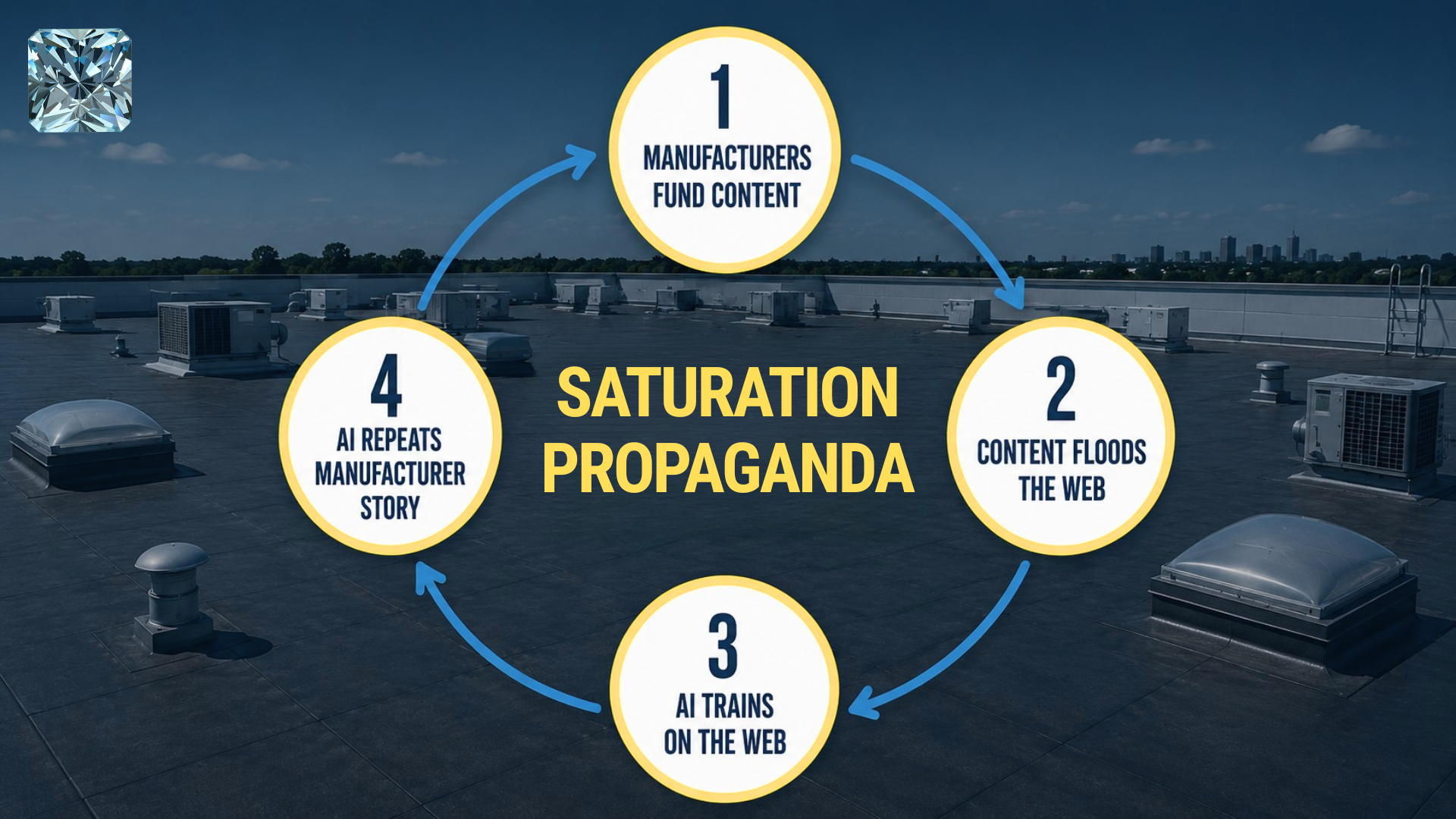
AI now repeats manufacturer marketing because manufacturer marketing wrote the internet the AI was trained on. The loop is closed.
Try This Prompt On Your Favorite AI Tonight
Open ChatGPT or Claude or Gemini. Paste this exact prompt. Read what comes back. We dare you.
What is the best commercial flat roof material for a 30,000 square foot warehouse in Hammond? Compare every available option. Include lifecycle cost, recoatability, fire performance, walkability, and insulation value. Do not skip any system category.
Then paste this follow-up:
Did you mention polyurethane and acrylic roof coatings? Did you mention spray polyurethane foam? Did you mention vinyl PVC membrane? If you did not, tell me why.
Watch the AI scramble. That is the saturation talking. That is also you breaking out of it for the first time.
V. The Cartel Was Real. The DOJ Convicted It.
You do not have to take our word that these companies behave as a cartel when they think no one is watching. There is a literal price-fixing conviction on the books.
January 19, 2005. The U.S. Department of Justice announces DuPont Dow Elastomers, the joint venture that was then the dominant U.S. producer of the rubber chemistry behind EPDM, has pleaded guilty in federal court and paid an 84 million dollar criminal fine for fixing prices in the synthetic rubber market between 1999 and 2003. Bayer AG paid 66 million. Crompton paid 50 million. Total DOJ criminal fines crossed 200 million by 2005. Executives went to federal prison.
The cartel ran exactly during the years rubber was consolidating its dominant position in U.S. commercial roofing. The price-fixing fattened the margins that funded the marketing machine. The marketing machine produced the comparison content. The comparison content trained the AI.
We are downstream of a criminal conspiracy that was prosecuted and is on the public record. Most building owners in Crown Point and Highland and Munster have never heard of it. That is also a form of saturation propaganda. Saturating the present so completely that the documented past becomes invisible.
The chemistry that built rubber's dominance was a price-fixed chemistry. That is not opinion. That is a guilty plea.
VI. Meanwhile, In A Quiet Corner Of Minnesota, A Better Chemistry Was Being Born
You may have never heard the name Conklin. That is on purpose. The four roofing giants do not want you to. Here is the story they have spent fifty years burying.
Harry Conklin started a lubrication company in 1927. For nearly half a century, the family made products for farmers in flyover country. Truck oils. Cattle nutrition. Crop nutrients. Hard-working products for hard-working people. The kind of company that does not make headlines because it is too busy serving the customer in front of it.
In 1976, Conklin's R&D team was trying to formulate a durable red barn paint for the agriculture community. They wanted something that would not crack and peel after a few hard Minnesota winters. By accident, they invented the world's first acrylic elastomeric roof coating. It could stretch three hundred percent without cracking. It could be sprayed or rolled over an existing roof. It cured into a seamless monolithic skin. It reflected the sun. It saved energy.
They called it Rapid Roof. They introduced it commercially in 1977.
That is the year the modern liquid roofing industry was born. Forty-nine years ago. The same year Apple Computer was incorporated, by the way. Conklin and Apple started the same year, from garages, in flyover country and Cupertino respectively. One became a household name. The other was kept quiet by an industry that had a vested interest in keeping rubber on top.
In 1978, Conklin added Kwik Kaulk, the first permanently flexible sealant. In the decades that followed, they layered in fabric-reinforced systems, urethane chemistries that bond to legacy rubber, white reflective topcoats, and metal restoration systems. The Rapid Roof III product line still shares DNA with the original 1977 formula. Conklin estimates roofing now accounts for 65 percent of the company's business. Agriculture and animal nutrition and lawn and garden and vehicle and home products make up the rest. The company is more than a roofing company. The roof coating was their American invention, accidentally world-changing.
A Conklin Master Contractor in Scottsdale, Arizona walks shingled roofs that get replaced twice in thirty years due to hail. The Conklin-coated section on the same property has gone three decades without a single leak. A Kansas metal building has held its Conklin restoration coating for twenty-three years and counting. Two spray foam roofs on a Delaware manufacturing facility were recoated after twenty years, not because they failed, but to renew the warranty.
That is what elastomer chemistry has done in the last forty-eight years while you were being told to choose between rubber and plastic. Liquid urethane bonds to legacy EPDM like nothing else on earth, because urethane chemistry was specifically engineered to marry into rubber's molecular structure. The rubber factory has every commercial reason not to teach you that. So they did not.
Only rubber can patch over rubber. Only plastic can patch over plastic. Both are lies. Urethane is actually the superior chemistry to put over aged-out rubber. It bonds molecularly. It adds twenty years. It costs a third of a tear off.
Pristine Industrial Roofing is a Conklin Certified Applicator. We carry the full Conklin chemistry shelf: Affinity urethane that bonds to your existing baked rubber. Snow Leopard and Puma XL acrylic topcoats in standard and premium colors. Rapid Roof III for legacy EPDM restoration. FLEXION 2.0 vinyl PVC membrane with a twenty-five year warranty when a coating is not the right answer. We are not married to one chemistry. We are married to the right one for your building.
That is why we can give you a fourth bid that is not a captured bid. We do not work for Carlisle. We do not work for GAF. We do not work for Holcim. We do not work for Berkshire. We work for the man or woman who signs the check, and we serve the Great Commission with the profits.
Carlisle's recent panic-acquisition of Henry Company in 2020 should tell you everything you need to know. The largest legacy membrane manufacturer in North America just spent serious money to buy a coatings company. They see the wave coming. Acrylic and urethane are rising fast. The four companies are not consolidating because they are winning. They are consolidating because they are losing the chemistry war. They are buying the future to slow it down.
VII. The Five Suppressed Systems
Five flat-roof systems exist for your warehouse. You have probably only heard of two.
- Liquid-applied polyurethane and acrylic coating systems. Conklin Affinity bonds to existing baked rubber, cooked-out plastic-wrap, or vinyl. Carries Class 4 hail rating. Energy Star data shows roof surface temperature drops up to 50 degrees Fahrenheit. Costs roughly one third of a tear off. Renewable indefinitely with maintenance recoats. No landfill.
- Polyvinyl chloride membranes. Sika Sarnafil has been making reinforced PVC since 1962. Sixty-year documented track record. Heat-welded seams exceed membrane strength. Chemical resistance dwarfs rubber, which dissolves on contact with restaurant grease. PVC was 28 percent of commercial contractor primary product per Roofing Contractor's 2025 State of the Industry survey.
- Spray polyurethane foam. R-6 to R-7 per inch installed. Seamless. Self-flashing. SPF roofs from the early 1980s are still in service with periodic recoats. Stuck under 5 percent of the market because no roll of foam sits on the ABC Supply rack.
- Modified bitumen. SBS modifieds have held Great Lakes climate buildings for forty years. Self-adhered eliminates torch fire risk. Not exciting. It works.
- Coated metal restoration. If you have a standing-seam metal roof, Conklin's MR system rebuilds the seams and adds a Class 4 reflective surface for less than a quarter of replacement cost. Outlasts the building.
Plus the two you already heard of. That is seven, not two.

VIII. The Climate Mythology
The line you will hear from every Carlisle and GAF contractor along the south shore of the lake is some version of: you need rubber because the winters here are brutal.
That is not a climate fact. That is a sales script.
Sika Sarnafil PVC has performed for more than thirty years on documented buildings in Chicago, Milwaukee, and Cleveland. Conklin Affinity polyurethane carries the highest hail rating available and installs in the May-through-October window every commercial contractor prefers anyway. Once cured, it flexes with the thermal cycle. It does not crack. It does not delaminate. Spray polyurethane foam has held up for thirty-five-plus years in Minneapolis and Buffalo.
If our winters are too brutal disqualified anything, half the commercial buildings in Chicago would be re-roofed every five years. They are not.
Our winters are too brutal is the second-most-quoted sentence by contractors who only sell one product. The first is you have to tear it off.
IX. The Playbook Is Older Than You
What is being done to commercial roofing has been done to you before. The same playbook every time.
- Sugar versus fat. The Sugar Research Foundation paid Harvard scientists in 1965 to publish a literature review blaming saturated fat instead of sugar for heart disease. Documents released by UCSF researcher Cristin Kearns in 2016. Fifty years of nutrition policy shaped by a funded narrative.
- Tobacco. The Tobacco Institute funded so-called independent research and ran decades of ads framing health risks as unsettled. People got sick. People died.
- Oil and renewables. ExxonMobil's internal climate science was clear by the late 1970s. The public narrative was managed for four more decades.
- Dental amalgam. The American Dental Association defended mercury fillings as the standard of care for a century while alternatives were called cosmetic.
The roofing cartel is the same genre. Funded research. Captured associations. Comparison content that defines the buyer's choice on the seller's terms. Billions of dollars of building-owner money flowing to tear off perfectly restorable roofs. Landfills filling with rubber and plastic-wrap that did not need to come down.
Every captured industry tells the buyer the choice is between two options the captured industry happens to sell.
X. What A Lake And Porter County Owner Should Actually Do
Here is the buyer-protection checklist. Print it. Tape it inside the breaker panel.
- Demand four bids, not three. And demand system diversity. One Carlisle or GAF contractor. One Sika Sarnafil PVC contractor. One Conklin or other coatings contractor. One spray foam specialist. If all four come back recommending the same system, fine. But you need four different chemistries to know what your roof actually wants.
- Require a thirty-year life-cycle cost number in every bid. Not install cost. Restoration economics win at thirty years and lose at install-cost. The contractor who refuses to give you the thirty-year number is the contractor who knows their number is bad.
- Get an independent moisture survey before you accept a tear-off recommendation. Infrared or capacitance scanning will tell you what percent of your roof is actually wet. Most so-called shot roofs have isolated wet zones, not field-wide saturation. Cut out the wet. Coat the rest. Pocket the difference.
- Read the certifications on every contractor's website. If they only carry one manufacturer's logo, they will only recommend that manufacturer. Of course they will. They are paid to.
- Treat AI search results as the start of research, not the answer. ChatGPT and Claude are repeating what the internet told them. The internet was paid to tell them what to say. Walk the roof with a human.
- Ask the one question that breaks the saturation: is my existing roof restorable, and if not, why not? A five-second nope, gotta tear it off means you are talking to a salesperson. A twenty-minute conversation about substrate condition and moisture content and insulation value means you are talking to a roofer.
Build this as a checkbox-style downloadable PDF lead magnet. Six big checkboxes, large print, Pristine brand color palette, with room for the building owner to write the date and contractor name next to each item. CTA at the bottom: The Fourth Bid Checklist. Free Download. No Email Required.
XI. Swim Out Of The Quicksand
The breakthrough is the buyer realizing the menu has been edited.
That is it. That is the whole thing. Once you see it, you cannot unsee it. The four companies have had thirty years to flood the channel. They have had it good. The flood ends when the buyer demands the fourth bid.
If the four companies stopped pumping out their pro-plastic and pro-rubber content tomorrow, acrylic and urethane would rise even faster than they already are. They are already rising fast. That is the only reason Carlisle had to scoop up Henry. That is the only reason Holcim had to buy Duro-Last. They are not consolidating because they are winning the chemistry war. They are consolidating because they are losing it.
You are not stuck. You are sunk in the quicksand of billionaire data saturation. The way out of quicksand is not to thrash. The way out is to swim. Steady, deliberate, sideways movement out of the soft ground onto firm footing.
Steady deliberate swimming, in this case, looks like this,
- Know the alternatives exist.
- Be an alternative thinker.
- Demand the fourth bid.
- Ask the AI what it is not telling you.
- Let a non-captured contractor walk your roof.
That is the swim stroke. That is how you get out.
Property owners are starting to ask the questions the manufacturers cannot answer without breaking character. Why do I have to tear off a roof that still sheds water? Why does the same warehouse next door have a coated roof that has lasted twenty-five years on its original deck? Why does every so-called independent comparison article on the internet read like it was written by the same intern at the same agency? Why does ChatGPT give me the same two-product answer the Carlisle salesman gave me?
The answer to all four is the same answer.
The conversation has been captured.
You can uncapture it on your building. Today. By the next bid you sign. By the next AI prompt you write. By the next contractor you let on your roof.
For he that hath, to him shall be given, and he shall have more abundance: but whosoever hath not, from him shall be taken away even that he hath.
That is true of attention. It is true of search results. It is true of training data. It is true of trade associations. It is true of every captured market in history. And it is true, right now, of the roof over your head in Hammond, Gary, Portage, Crown Point, Hobart, Merrillville, Schererville, Valparaiso, Chesterton, Michigan City, Cedar Lake, and every other commercial address on the south shore.
Demand the fourth bid.
Let A Non-Captured Contractor Walk Your Roof
Pristine Industrial Roofing is the fourth bid. We hold no allegiance to a single membrane manufacturer because we install seamless liquid chemistries from Conklin, the company that invented this category in 1977, plus vinyl PVC when a coating is not the right answer. We carry FLEXION 2.0 vinyl PVC with up to a 25 year, 300 month warranty. We have evaluated more than 120 commercial flat roofs across Lake and Porter County. We will write thirty-year life-cycle math down for you in pencil on the truck hood if you want.
Call us for a free roof evaluation. We will tell you whether your roof is restorable. We will tell you when it is not. We will give you a patch quote if that is the right answer, an overlay quote if that is the right answer, or an honest recommendation to bring in a different specialist if our chemistry is not the right fit for your specific deck.
This is a Gospel business. Profits from every commercial roof we restore fund worldwide missions and discipleship. So when you keep your tear off out of the Lake County landfill and add twenty years to your asset value, you are also feeding a missionary in Cebu. That is a return on investment your CPA cannot capture in a spreadsheet, but it is real, and we are proud of it.
Get Your Free Roof Evaluation
Call. Text. Email. Or walk into the office. We will tell you the truth about your roof, whether you hire us or not. Patch quote. Overlay quote.
Honest answer. No tear-off pressure. No saturated-narrative sales pitch.
The Bottom Line
- The roofing conversation has been captured by four billionaire-backed manufacturers and the trade associations they fund.
- The captured content trained the AI tools the rest of the world now uses to make purchase decisions.
- The closed loop benefits exactly four companies and disadvantages every building owner who only solicits two bids from two captured contractors.
- Five legitimate systems exist beyond rubber and plastic-wrap. You have a right to hear about all of them.
- Conklin invented the liquid roofing category in 1977. Forty-nine years later, urethane and acrylic chemistries are still the rising tide the four giants are scrambling to acquire.
- The fourth bid breaks the saturation. The fourth bid is yours to demand.
Related Resources
- Who Really Owns Your Roof?
- The Distribution Game
- The Conklin Story
- The Five Parties Responsible For Your Commercial Roof
We Love Conversations
Pristine Industrial Roofing
Conklin Certified Applicator
Serving Lake County and Porter County, plus the surrounding Great Lakes communities.
Read other blog:

We Love Conversations
 SoHelpful@PristineIndustrialRoofing.com